

Sound: How the Air Learns to Talk
Music, voices, footsteps, thunder — sound is everywhere. It fills rooms, travels through walls, and somehow turns tiny movements into emotions, warnings, and entire conversations. But at its core, sound isn’t magic. It’s just air… being pushed around in very organized ways.
Let’s break down how that actually works.
Sound Is a Vibration, Not a Thing
Sound isn’t an object you can hold. It’s a vibration — a back-and-forth movement that travels through a material like air, water, or solid objects.
When something makes a sound, it moves. A guitar string wiggles. A speaker cone pulses. Your vocal cords vibrate. That motion pushes nearby air molecules, which then push the next ones, and the next, creating a traveling wave of pressure.
Nothing is flying across the room from the speaker to your ear.
The air itself is just passing the motion along.
Waves, But Not Like Ocean Waves
Sound travels as a compression wave. That means the air gets slightly squished together, then spread out, over and over again as the wave moves forward.
Think of it like this:
- Compressed air → slightly higher pressure
- Spread-out air → slightly lower pressure
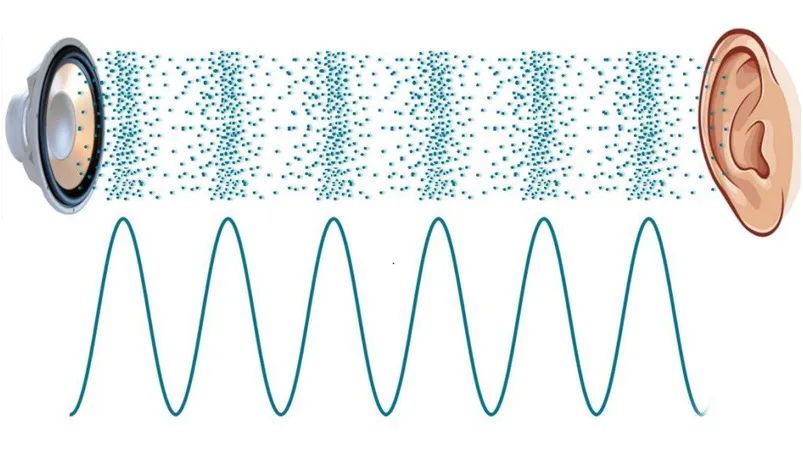
These pressure changes are tiny, but your ears are sensitive enough to detect them and turn them into something your brain recognizes as sound.
So when you hear a song, what’s really reaching you is a carefully shaped pattern of pressure changes in the air.
Pitch: Why Some Sounds Are High and Others Are Low
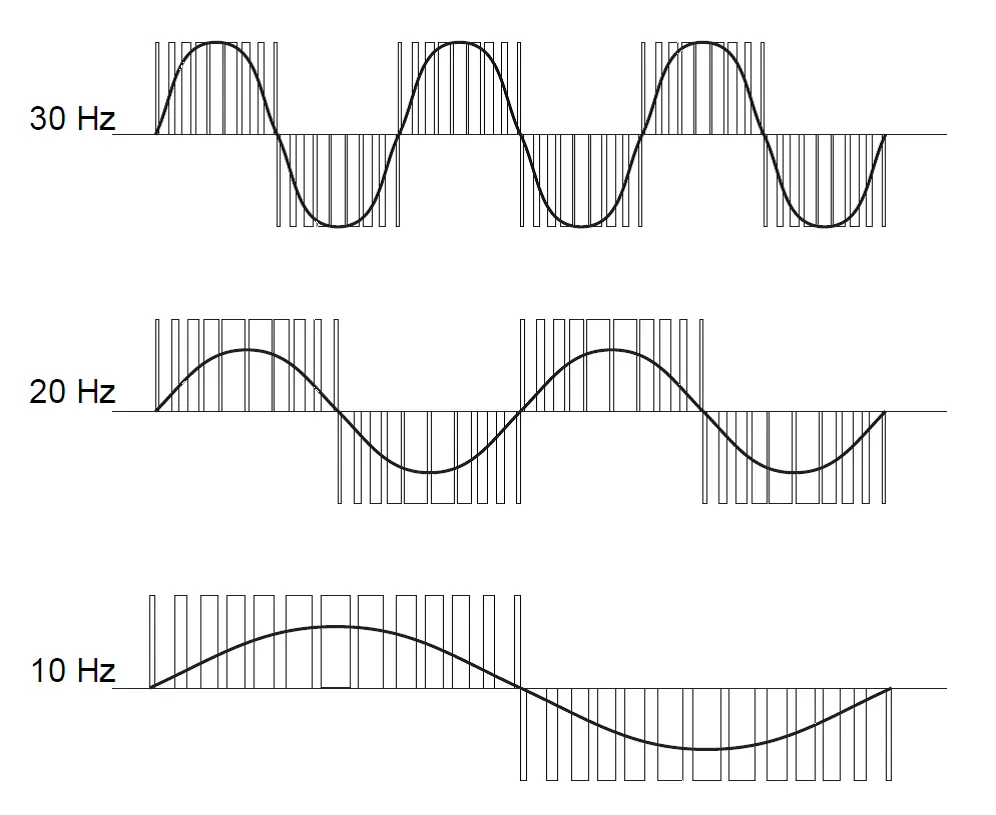
Not all vibrations are the same speed. Some happen slowly, others extremely fast.
This speed is called frequency, measured in hertz (Hz), which means “vibrations per second.”
- Low frequency → slow vibrations → low-pitched sounds (like thunder or bass)
- High frequency → fast vibrations → high-pitched sounds (like whistles or birds)
Human hearing ranges roughly from 20 Hz to 20,000 Hz. Below that, we can’t hear it (but we might feel it). Above that, dogs might notice, but we won’t.
Every note in music is basically just a specific vibration speed.
Loudness: How Big the Vibration Is
While pitch depends on how fast something vibrates, loudness depends on how much it moves.
Bigger vibrations push the air more strongly, creating larger pressure changes. Your ears interpret this as louder sound.
That’s why:
- Gently tapping a drum sounds quiet
- Hitting it hard sounds loud
Same object, same pitch, just a bigger movement of air.
Loudness is measured in decibels (dB), but the scale isn’t linear. An increase of just a few decibels can feel like a big jump in volume.
How Your Ear Turns Air Into Information
Your ear is basically a biological sensor designed to read air vibrations and convert them into electrical signals for your brain.
Here’s the simplified path:
- Outer ear collects sound waves
- Eardrum vibrates with the air pressure
- Tiny bones in the middle ear amplify the motion
- Inner ear (cochlea) converts vibrations into nerve signals
- Brain turns signals into what you experience as sound
Your brain then adds meaning: speech, music, danger, comfort, nostalgia. The physics stops at the ear — everything after that is perception.
Sound Needs Something to Travel Through
One important detail: sound cannot travel through empty space.
No air, no water, no solid material — no sound.
That’s why space is silent, even when explosions look dramatic in movies. There’s nothing there to carry the vibrations. Sound always needs a medium to move through.
Interestingly, sound actually travels:
- Slower in air
- Faster in water
- Even faster in solid objects
That’s why you can hear a train through the tracks before you hear it through the air.
From Physics to Feelings
What makes sound special isn’t just the science — it’s how deeply it connects to human experience.
The same physical process can be:
- A song that changes your mood
- A voice you recognize instantly
- An alarm that triggers panic
- A rhythm that makes you move
All of that starts with simple vibrations, shaped over time into patterns that our brains are incredibly good at decoding.
Sound is proof that tiny movements can carry huge meaning.
Tiny Motions, Massive Impact
At the smallest level, sound is just particles bumping into each other. But from that simple process comes language, music, warnings, stories, and entire cultures built around listening.
So the next time you put on headphones or hear rain hitting a window, remember:
you’re not just hearing noise — you’re feeling organized motion traveling through the air, straight into your mind.
And somehow, your brain turns that motion into meaning.